If you own a sloping block in Brisbane, you have almost certainly thought about retaining walls. They are essential for creating usable flat areas, preventing erosion, and protecting your home's foundations from soil movement. The two most common materials for residential retaining walls in Brisbane are concrete and timber, and the debate over which is better has been going on for decades.
At Concrete Concepts Group, we specialise in concrete retaining walls across Brisbane and South East Queensland. But we are not going to pretend timber does not have its place. This guide gives you an honest, side-by-side comparison of concrete versus timber retaining walls so you can make the right decision for your property, your budget, and your long-term plans.
The Quick Answer
If you want the short version: concrete retaining walls cost more upfront but last 50+ years with virtually zero maintenance. Timber retaining walls are cheaper initially but deteriorate within 15 to 25 years and will need to be replaced.
For walls under 600mm in height on non-critical applications (garden beds, landscape features), timber can be a sensible and cost-effective choice. For anything structural, over 1 metre high, or retaining soil near a building, concrete is the superior option in almost every scenario.
Now let us break down the details.
Cost Comparison
Timber Retaining Wall Costs in Brisbane
Treated pine sleeper walls are the most affordable retaining wall option in Brisbane. For a standard treated pine retaining wall up to 1 metre high, you can expect to pay between $150 and $300 per lineal metre installed.
Hardwood sleeper walls (using ironbark or spotted gum) are more expensive, typically $250 to $450 per lineal metre installed. Hardwood lasts longer than treated pine but is significantly heavier and harder to work with, which increases labour costs.
A typical 10-metre-long timber retaining wall at 1 metre high will cost between $1,500 and $4,500 depending on the timber species and site conditions.
Concrete Retaining Wall Costs in Brisbane
Concrete retaining walls come in several forms, each with different cost profiles.
Concrete sleeper walls (precast concrete panels slotted into steel posts) are the most popular option in Brisbane. They cost between $250 and $500 per lineal metre installed for walls up to 1 metre high. This is the closest concrete equivalent to a timber sleeper wall and offers a similar aesthetic with dramatically better longevity.
Poured concrete retaining walls (reinforced concrete cast in situ) are the strongest option and cost between $400 and $800 per lineal metre for walls up to 1.5 metres high. These are typically specified by engineers for walls that retain significant loads or are close to buildings.
Concrete block retaining walls (using Besser blocks or similar) cost between $300 and $600 per lineal metre and offer good strength with a rendered or painted finish.
A typical 10-metre-long concrete retaining wall at 1 metre high will cost between $2,500 and $5,000 for concrete sleepers, or $4,000 to $8,000 for poured concrete.
The True Cost: Lifecycle Analysis
Here is where the comparison gets interesting. A timber retaining wall installed in 2026 will likely need to be replaced by 2041 to 2051 (15 to 25 years). A concrete retaining wall installed in 2026 will still be standing in 2076 and beyond.
If you install a $3,000 timber wall today and replace it once in 25 years (at inflated future costs of approximately $5,000), your total 50-year cost is $8,000 plus the disruption and landscaping damage from the replacement.
A $5,000 concrete wall installed today has a 50-year cost of $5,000 with no replacement, no disruption, and no ongoing maintenance beyond occasional cleaning.
Over the lifetime of the wall, concrete is actually cheaper.
Durability and Lifespan
Timber
Treated pine retaining walls in Brisbane typically last 15 to 20 years before the timber begins to rot, split, and lose structural integrity. The hot, humid Brisbane climate accelerates timber deterioration, and termites are an ever-present threat despite the treatment.
Hardwood sleepers last longer (20 to 30 years) but are not immune to decay. Even ironbark, which is one of the hardest timbers available, will eventually succumb to moisture, fungal attack, and insect damage when in constant contact with soil.
The first signs of failure are usually visible after 10 to 15 years: the timber starts to bow outward, gaps appear between sleepers, and the posts begin to lean. By this stage, the wall is losing its structural capacity and will eventually fail.
Concrete
A properly engineered and constructed concrete retaining wall has a design life of 50 to 100 years. Concrete does not rot, is not attacked by termites, and is not affected by Brisbane's humidity.
Precast concrete sleepers are manufactured under controlled conditions with consistent concrete strength and steel reinforcement. They do not warp, bow, or split. The steel posts are galvanised to resist corrosion, and the concrete panels are designed to withstand the lateral earth pressures specified by the engineer.
Poured concrete walls are even more durable, as they are a single monolithic structure with continuous steel reinforcement. These walls can retain significant loads and are the preferred option for walls adjacent to buildings, driveways, and swimming pools.
Structural Performance
Load-Bearing Capacity
Timber retaining walls have limited load-bearing capacity. Most timber walls are designed to retain soil only and should not have vehicles, buildings, or heavy structures placed on the retained side within a certain distance of the wall.
Concrete retaining walls can be engineered to carry significant surcharge loads. If you need a retaining wall near your driveway, adjacent to a building pad, or supporting a pool surround, concrete is the only sensible option.
Height Limitations
In Queensland, any retaining wall over 1 metre in height requires engineering design and building approval. Timber walls become increasingly impractical above 1 metre because the timber posts need to be very deep and the lateral loads on the timber exceed its structural capacity.
Concrete retaining walls can be engineered to any height required. Walls up to 3 metres are common in residential applications, and commercial concrete retaining walls can be 10 metres or more.
Drainage
Both timber and concrete retaining walls require proper drainage behind the wall. This typically involves agricultural pipe (ag pipe) laid behind the base of the wall, surrounded by gravel, with weep holes through the wall face to allow water to escape.
Poor drainage is the number one cause of retaining wall failure in Brisbane, regardless of the material. Water builds up behind the wall, increases the lateral pressure, and eventually pushes the wall over. We have seen this happen with both timber and concrete walls, although timber walls fail much sooner because the timber itself absorbs water and weakens.
Maintenance Requirements
Timber
Timber retaining walls require regular maintenance to maximise their lifespan. This includes annual inspection for signs of rot, termite damage, and structural movement. Treated pine walls should be re-stained or sealed every 2 to 3 years to slow moisture absorption. Any damaged sleepers should be replaced promptly before the wall loses structural integrity.
Despite best maintenance efforts, timber walls will still deteriorate and eventually need full replacement.
Concrete
Concrete retaining walls require virtually no maintenance. An occasional pressure wash to remove algae or dirt is all that is needed to keep them looking good. There is no staining, no sealing, no termite treatment, and no replacement of individual components.
If a concrete wall is damaged (for example, by a vehicle impact), individual precast panels can be replaced without rebuilding the entire wall. Poured concrete walls can be repaired with patching compounds for minor surface damage.
Aesthetic Options
Timber
Timber has a natural, warm aesthetic that suits bush-style gardens and informal landscapes. Treated pine can be stained in various colours, and hardwood has a rich natural grain that many homeowners find attractive.
However, the aesthetic appeal of timber diminishes as the wall ages. Within 5 to 10 years, the timber fades, greys, and begins to show signs of weathering. Staining can slow this process but cannot prevent it entirely.
Concrete
Modern concrete retaining walls offer far more aesthetic options than most people realise. Precast concrete sleepers are available in a range of colours and textures, including sandstone, timber-look, and smooth modern finishes. They can be painted or rendered to match any architectural style.
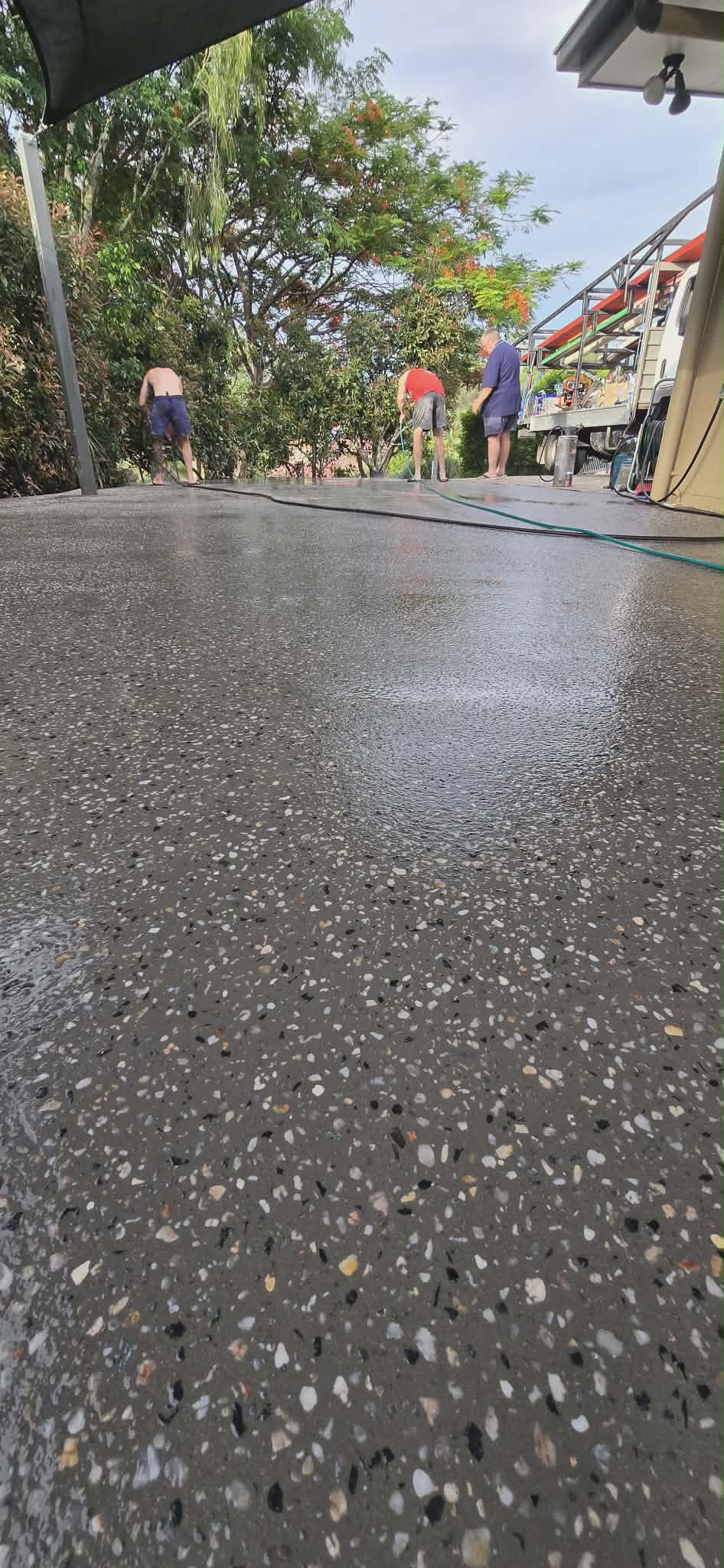
Poured concrete walls can be finished with exposed aggregate, stamped patterns, or rendered and painted. The design possibilities are virtually unlimited, and the finish will last as long as the wall itself.
Visit our finishes visualiser to see the range of concrete finishes available for retaining walls and other concrete structures.
When to Choose Timber
Timber retaining walls make sense in specific situations. For low garden walls under 600mm that are purely decorative and not retaining significant soil loads, timber is a cost-effective option. For temporary walls on properties that will be redeveloped within 10 to 15 years, the lower upfront cost of timber may be justified. For bush-style properties where a natural timber aesthetic is important and the homeowner is willing to accept the maintenance and replacement costs, timber can be the right choice.
When to Choose Concrete
Concrete retaining walls are the better choice for any wall over 1 metre high, any wall near a building, driveway, or pool, any wall on a property you plan to keep long-term, any wall where low maintenance is a priority, and any wall that needs to support surcharge loads.
For most residential retaining wall projects in Brisbane, concrete is the superior long-term investment.
The Concrete Concepts Group Approach
We design and build concrete retaining walls across Brisbane, from simple garden walls to complex multi-level terracing on steep blocks. Every wall we build is engineered to comply with Australian Standards and Queensland building regulations.
Our process starts with a free site assessment where we inspect the slope, soil conditions, drainage, and any nearby structures. We then work with our structural engineer to design a wall that meets the specific requirements of your site.
As a QBCC Licensed contractor (Licence #15299707), we handle the full scope: excavation, drainage installation, steel fixing, concrete pouring, and backfilling. One contractor, one quote, one point of accountability.
Get Your Free Retaining Wall Quote
If you are considering a retaining wall for your Brisbane property, we would love to help. Whether you have already decided on concrete or you are still weighing up your options, our free site assessment will give you the information you need to make the right decision.
Request a free quote online or call us on 0424 463 268.
Brisbane Council Requirements for Retaining Walls
Understanding the regulatory requirements in Brisbane is essential before building any retaining wall, regardless of the material.
In the Brisbane City Council area, retaining walls under 1 metre in height that are more than 1.5 metres from a boundary generally do not require building approval. However, they must still comply with the Queensland Development Code and not adversely affect neighbouring properties.
Retaining walls over 1 metre in height require a structural engineer's design and building approval from a private certifier. This applies to both concrete and timber walls. The engineering design must account for the soil type, surcharge loads (anything on top of the retained soil, such as vehicles, buildings, or heavy landscaping), drainage requirements, and proximity to boundaries and buildings.
Retaining walls within 1.5 metres of a boundary may also require development approval, regardless of height. This is because they can affect the neighbour's property through changes in drainage patterns, soil pressure, and visual amenity.
The approval process typically takes 2 to 4 weeks and costs between $500 and $1,500 for the engineering design plus $300 to $800 for the building approval. These costs apply equally to concrete and timber walls.
Real-World Case Studies from Brisbane
To illustrate the practical differences between concrete and timber retaining walls, here are three scenarios based on actual projects in Brisbane.
Case Study 1: Garden Terrace in Paddington
A homeowner in Paddington needed a 600mm-high retaining wall to create a level garden bed on their sloping backyard. The wall was 8 metres long, purely decorative, and not near any structures.
We recommended treated pine sleepers for this application. The wall cost $1,800 installed and was completed in one day. For a low, non-structural garden wall with a 15 to 20 year expected lifespan, timber was the right choice. The homeowner plans to renovate the entire backyard within 10 years, so the shorter lifespan of timber was not a concern.
Case Study 2: Driveway Retaining Wall in The Gap
A property in The Gap required a 1.5-metre-high retaining wall along a 12-metre driveway. The wall needed to support the weight of vehicles driving on the retained side, and it was within 1 metre of the property boundary.
This project required engineering design and building approval. We built a concrete sleeper wall with galvanised steel H-posts set in concrete footings at 2-metre centres. The total cost was $7,200 installed, including engineering, approval, excavation, drainage, and the wall itself.
A timber wall was not suitable here because of the surcharge load from vehicles, the height requiring engineering, and the proximity to the boundary (where future replacement would be disruptive and expensive). The concrete wall will last 50+ years with zero maintenance.
Case Study 3: Multi-Level Terracing in Mount Gravatt
A steep block in Mount Gravatt needed three levels of retaining walls to create a usable backyard. The walls ranged from 800mm to 1.8 metres high, with a total length of 35 metres across all three levels.
This was a significant engineering project. We built poured concrete retaining walls with continuous steel reinforcement, agricultural drainage behind each wall, and stepped footings to follow the natural slope. The total cost was $28,000, completed over two weeks.
Timber was never considered for this project. The heights, loads, and complexity required the structural integrity that only reinforced concrete can provide. The homeowner now has three level terraces connected by concrete steps, with the retaining walls doubling as seat walls for entertaining.
The Environmental Perspective
For environmentally conscious homeowners, the sustainability comparison between concrete and timber retaining walls is worth considering.
Timber retaining walls use a renewable resource, but treated pine is impregnated with chemical preservatives (typically copper chrome arsenate or CCA) that prevent it from being composted or burned at end of life. Treated timber must be disposed of at a licensed facility, and the chemicals can leach into surrounding soil over time.
Concrete retaining walls have a higher embodied energy (the energy required to manufacture the materials), but their 50+ year lifespan means the environmental impact per year of service is actually lower than timber walls that need replacement every 15 to 25 years.
At end of life, concrete can be crushed and recycled into road base and aggregate, making it one of the most recyclable construction materials. Steel reinforcement is also fully recyclable.
Related Pages on Our Site:
- Retaining Walls Brisbane — Full details on our retaining wall services
- Excavation Brisbane — Site preparation for retaining walls
- Concrete Driveways Brisbane — Driveways adjacent to retaining walls
- Cost Calculator — Get an instant estimate for your project
- View Our Before & After Gallery — See completed retaining wall projects
- Customer Reviews — What our clients say about our retaining wall work
Get a Free Quote for Your Project
No obligation — we'll call you within 24 hours to discuss your needs.
Concrete Concepts Group
QBCC Licensed (#15299707) concreting professionals serving Brisbane and all surrounding areas. Over 100 projects completed with a 5-star reputation.
Explore Our Services
We Service These Brisbane Areas
Homeowner's Guide to Concreting
13-page guide covering finishes, costs, council requirements, and maintenance tips for Brisbane homeowners.
Download Free